Breaking the Silence Begins with Us
As CEO of Kitsap Mental Health Services, the largest mental health organization in the county, I know all too well the very real stigma surrounding mental health. I’ve not only seen it in our community, I’ve experienced it in my own life. Like many people, I was raised in a loving family where mental illness was never talked about. And as I’ve come to learn, what we don’t talk about sends a powerful message about what is acceptable—and what is not. The absence of conversation about our feelings and emotions…the silence…becomes internalized. It stuck with me. Even now, after years in this field, it can still make openness feel risky and vulnerable.
Sharing My Story
The stigma surrounding mental illness came into sharp focus for me personally in my thirties, when I found myself struggling while parenting two young children and navigating a major life transition. I had stepped away from my professional career in finance to become a stay-at-home mom. And while I was aware that I was incredibly fortunate to be able to make this choice at that time, it was also incredibly disorienting and isolating.
I remember one day in particular, when shortly after the transition my 4-year-old son screamed, “You’re a bad mommy!” in response to something I did or didn’t do. In that single moment, I felt I had just failed the only performance review that ever mattered to me. My education and career, not to mention life experience, had never prepared me for these challenges.
Words like depression and anxiety were abstract concepts—words that I may have used in conversation but definitely didn’t recognize in myself. So, when I finally sought care and my doctor gently suggested that depression might be part of what I was experiencing, I thought, “Absolutely not,” holding back tears as I dismissed the idea of medication alongside therapy. That kind of help was meant for other people. Not me.
But it wasn’t just for other people, was it?
The Big Picture
Here in Washington State, one in five adults experiences a mental health condition each year, and nearly 388,000 adults are living with serious mental illness. Yet fewer than half receive treatment—often because of stigma, cost, or fear of being judged.
I was one of them. My depression deepened until it became abundantly clear that my personal determination and willpower alone were not enough to allay the darkness and sadness that surrounded me. When I finally allowed myself to accept both counseling and medication, the impact was profound. It was no different than using medication to manage blood pressure—or any other tool we rely on to support physical health.
I am grateful to work in an organization where mental health treatment and recovery are not just words but actually a lived reality. Many KMHS employees were drawn to this work because of their own journeys—because they understand recovery, resilience, and relapse at a deeply human level, and they choose every day to walk alongside others in their healing.
Breaking the Silence
May is National Mental Health Awareness Month, which offers each of us a unique opportunity—and a responsibility—to push this conversation forward. We can normalize discussions about therapy, medication, recovery, and setbacks. We can challenge labels and assumptions. And we can support one another—because many of us, or the people we love, are living with these realities every day.
This Mental Health Awareness Month, I invite each of us to do one simple but meaningful thing: start a conversation. Share your story if you’re comfortable. Check in on a friend or colleague. Listen without judgment. And if you are struggling as you read this—please, please don’t navigate this journey alone. You deserve support. Please open yourself to the gift of healing and make use of the resources available in our community, just as you would for any other health need.
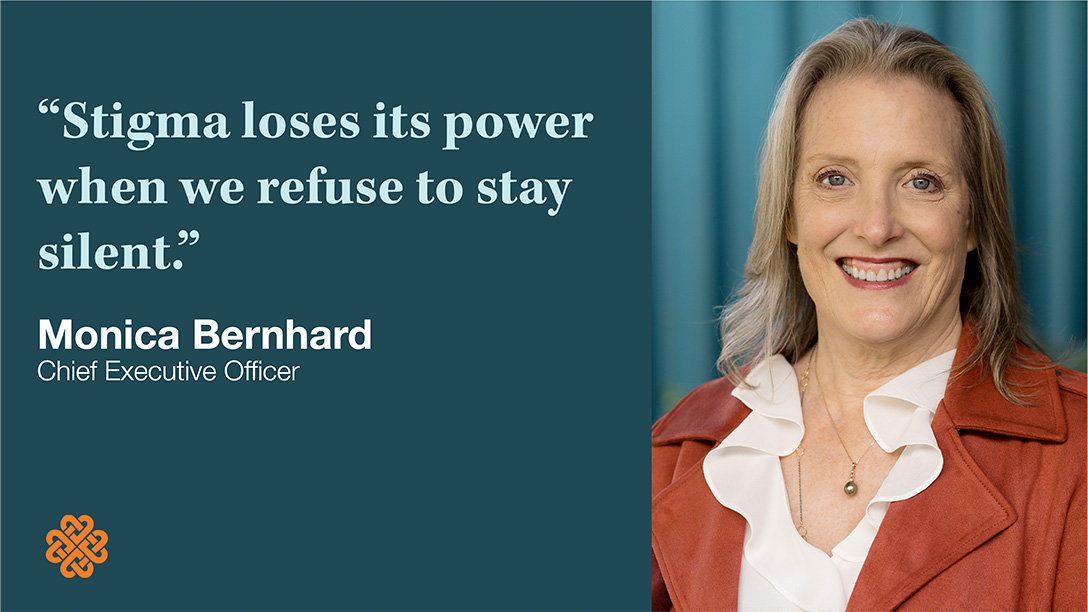
Stigma loses its power when we refuse to stay silent. And breaking the silence begins with us.
Monica Bernhard is CEO of Kitsap Mental Health Services and a longtime advocate for expanding access to housing, mental health treatment and substance use disorder treatment.